In November 2000, Followap and Eircell announced the world’s first commercial mobile instant messenger; it went live in Ireland that December. Over the six years that followed, its iFollow platform carried presence and messaging for Vodafone, Orange, Turkcell, 3, Wind and Mobinil — and the GSMA programme it was built for became RCS, the messaging in your phone today.
The first instant messaging service commercially available on mobile phones, with Eircell in Ireland.
Announced Nov, live Dec 2000
31+
Mobile operators running the platform, including Vodafone, 3, Orange, Telecom Italia, Turkcell and Beeline.
As reported, February 2008
300M
Combined subscriber base across customer networks at its peak — reported as “close to 300 million”.
2006–2007
$139M
Cash acquisition by NeuStar (NYSE: NSR).
November 2006
Our partnership with Followap allows us to deliver the world’s first mobile instant messaging service to our customers, and we are in no doubt that it will offer them real value.
Kieran Mahon Media Development Manager, Eircell (later Vodafone Ireland) Announcing ‘e-merge messenger’, 23 November 2000
2000 — 2008
Eight years, from a first message to a whole country interconnected
Followap shipped the first commercial mobile messenger, then spent the rest of the decade making it something operators could sell, standardise, and finally connect to one another — the work that became RCS.
Before 2000
The bet on presence
One idea underneath the company: that presence — knowing whether the person you want is actually reachable — belongs on the mobile network, attached to a phone number, not locked inside a PC application.
Nov 2000
The world’s first
Followap and Eircell sign on 23 November; ‘e-merge messenger’ goes live in Ireland that December — the first instant messaging service commercially available on mobile phones.
At 3GSM in Barcelona, the first multi-national agreement to interconnect mobile IM communities. Followap supplies the gateway that makes it work, and demonstrates it to the major operators at a GSMA meeting in the city.
Steve Jobs announces the iPhone six weeks after the sale closes; the App Store follows in July 2008. The operator-controlled distribution the platform was built for starts to dissolve almost immediately.
2007–08
Russia, then Malaysia
Beeline brings presence-enabled IM to 48 million VimpelCom subscribers; Celcom sets out to interconnect every mobile network in Malaysia — both under the GSMA’s Personal IM banner.
2008 → today
Personal IM becomes RCS
The GSMA takes Rich Communication Suite into its work programme; its founding features are Personal IM’s, plus in-call media sharing. RCS is now the messaging system on Android, and on the iPhone since 2024.
← Scroll the timeline →
Where it went
The GSMA called it Personal IM. You call it RCS.
In 2006 the GSM Association set out to give operators one interconnected messaging community, addressed by phone number, with presence in the address book. It named the programme Personal IM, and Followap built the platform it ran on, and demonstrated the interconnect to the major operators at a GSMA meeting in Barcelona that February.
The same programme, under a new name, became RCS: on Android for years, and on the iPhone since 2024.
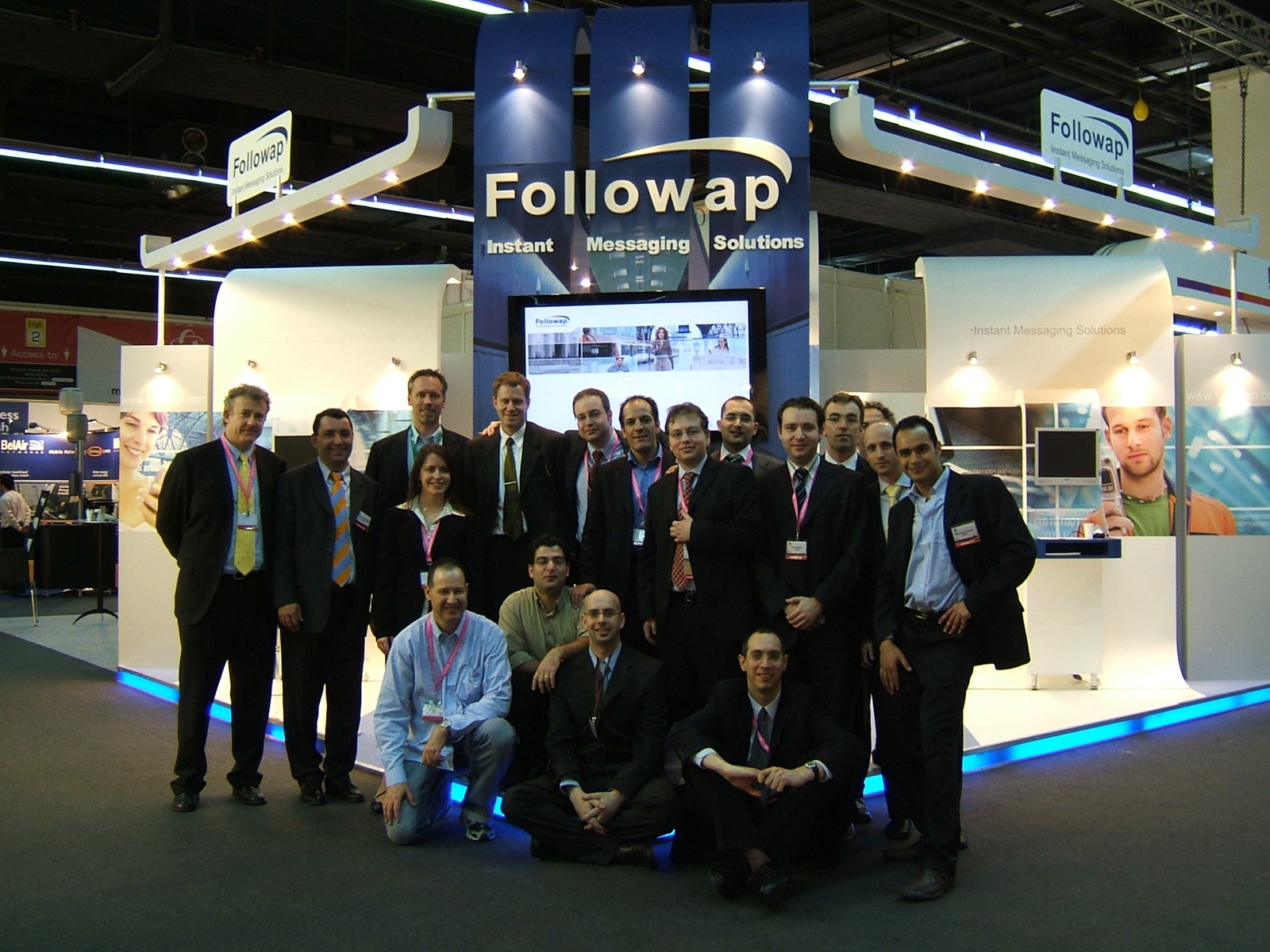
The Followap team at 3GSM, Barcelona, February 2006 — the congress where Orange and Vodafone agreed to interconnect, on Followap’s gateway.
The platform
iFollow
Four products that together let a mobile operator run its own messenger: a service centre, a presence layer, a federation gateway, and the clients that put it all in a subscriber’s hand.
IMSC
Instant Messaging Service Centre
The operator’s own messaging community, addressed by mobile number rather than a screen name. Branded by the carrier, billed by the carrier, and built to the same availability expectations as SMS.
Operator-branded IM communities
MSISDN as the identity
Carrier-grade redundancy and billing
Powered 15+ live communities by 2006
PSP
iFollow Presence Platform
The layer underneath everything else: collecting, managing and distributing availability from many sources, with group management and privacy controls. Later re-engineered as a SIP application server over 3GPP IMS.
Multi-source presence collection
Group management (GLMS)
SIP-based, IMS-ready
Presence Development Environment for third parties
ICP
Interconnect Platform
Federation for instant messaging. As with email, a message finds its recipient without either party caring which network or community they belong to — the piece that let Orange and Vodafone link their messengers.
Operator-to-operator federation
Bridges to internet IM communities
Secured authorisation and flexible billing
GSMA Personal IM aligned
Clients
Embedded and downloadable
The part subscribers actually touched: IM clients for 2G, 2.5G and 3G handsets, preloaded by manufacturers or downloaded, with the phonebook turned into a live buddy list.
First third-party IM client embedded by a handset maker
Siemens IC MobileSamsungMotorolaQualcomm BREWLG MobileJabberNMS CommunicationsHewlett-PackardNortel
Siemens IC MobileSamsungMotorolaQualcomm BREWLG MobileJabberNMS CommunicationsHewlett-PackardNortel
In their own words
The people who bought it
Operators, handset makers and technology partners, quoted in the announcements at the time, on what they had bought and why.
“This is a significant step in our ability to offer our customers advanced mobile services on a global basis. SMS already contributes a significant amount of revenue to Vodafone. Instant Messaging will help drive a new wave of SMS communication across our networks generating further revenues in this important messaging sector.”
“We believe that Followap is uniquely positioned to be the leader in providing Mobile Instant Messaging solutions and become the standard for IMPL platforms.”
President of Solutions, Information and Communication Mobile Group
“Moreover, for the first time, we will be able to provide operators with mobile devices that will enable their customers to truly benefit from advanced messaging services. This is quite a revolution in the mobile messaging market.”
“We are excited to see Followap extend the power of the BREW solution with presence and look forward to seeing the introduction of new innovative presence-based applications.”
Senior Vice President of Marketing and Product Management
“We selected Followap’s presence offering due to its functional robustness and its open architecture. The iFollow Presence Server will extend the functionality of the HP SDP with the ability to manage the numerous presence-enabled services offered or developed on the SDP.”
Worldwide Director, Network Domain Solutions, HP Network and Service Provider Solutions
“By introducing Followap’s solution in our network and enhancing our portfolio of services with TurkcellMessenger, we expect to provide our subscribers with unprecedented ease-of-use and accessibility to new services as well as existing ones.”
“As we have seen over the last few years, service interoperability has unlocked the true potential for mobile. … We hope to encourage all mobile operators to adopt this open, interoperable approach to instant messaging services.”
Chief Executive, announcing the IM link with Orange. Followap built Vodafone’s side of it, switched on the same day
“We’re really excited about the potential of IM and building on the already proven success of text-based conversation … we expect it to be adopted by a much wider audience over time.”
CEO, Orange Group, in the same announcement, linking Orange’s IM community to Vodafone’s
“Followap is the leader in its field, and has trusted, market proven embedded IM technology. We are developing handsets that meet our customers’ communication needs.”
“The iFollow IMSC and iFollow Clients have been chosen to provide our subscribers with Instant Messaging on their mobile devices. … This service will answer the needs of our customers, who enjoy SMS today, and are looking for real-time, presence-enabled communications.”
“We selected Followap’s IMSC and IM Clients to provide the best service to our customers, and we expect IM to become a core part of our service offering.”
“We selected NeuStar because of its experience in delivering reliable, convenient and revenue-generating IM solutions. We wanted to work with a company who shares our vision to enable personalised, advanced communications that will make a difference in how people use their mobile phones.”
Followap's iFollow, branded by Eircell as 'e-merge messenger', becomes the first instant messaging service commercially available on mobile phones — bridging WAP handsets and PCs.
At 3GSM Barcelona, Orange and Vodafone announce the first multi-national agreement to interconnect mobile IM communities under the GSMA's open-standard principles — the 'calling party pays' model applied to instant messaging.
NeuStar (NYSE: NSR) buys Followap in cash, citing a customer base of 17 mobile network operators covering over 160 million subscribers. Followap becomes the core of NeuStar's Next Generation Messaging group.
Nine years before WhatsApp existed, Eircell customers were exchanging instant messages between mobile phones and PCs. This site keeps the record of how that happened.